
Access to Work is the government scheme that pays for support disabled people need to do their job. It is genuinely valuable, and for people with sight loss or hearing loss the awards are among the largest the scheme makes. It is also widely misunderstood, waiting times are currently long, and there is one common misconception that costs employers and employees a great deal of time. This guide sets out what it actually does, as at August 2026.
The Most Important Point First
Access to Work does not pay for reasonable adjustments. GOV.UK states this explicitly, and Acas confirms that the scheme is not a substitute for an employer’s legal obligation to make reasonable adjustments or to pay for them.
This matters because the two are routinely confused. An employer who tells an employee to apply to Access to Work for something that is properly a reasonable adjustment has not discharged their duty under the Equality Act 2010, and has usually added several months of delay for no reason. The correct way to think about it is that the employer’s duty comes first, and Access to Work funds support that sits above and beyond that duty.
There is a useful corollary. Guidance from the Equality and Human Rights Commission lists the availability of financial support as one of the factors in deciding whether an adjustment is reasonable. So an Access to Work award does not remove the employer’s duty, but it does strengthen the argument that a particular adjustment is reasonable to make.
What Access to Work Covers
According to GOV.UK, an Access to Work grant can pay for:
- Specialist equipment and assistive software, which in practice covers screen readers, magnification software, braille displays and similar technology for sight loss.
- Support workers, including British Sign Language interpreters, job coaches and travel buddies. The Access to Work staff guide also names lipspeakers, note takers and palantypists.
- The costs of travelling to work where public transport cannot be used, and adaptations to a vehicle.
- Physical changes to the workplace.
- Mental health support, including a tailored plan and one-to-one sessions.
- Communication support at a job interview, which is applied for separately and must be arranged before the interview takes place.
A grant does not affect other benefits and does not have to be repaid. Costs are often paid up front by the employee or employer and reclaimed afterwards, which is worth knowing before committing to a purchase.
How Much Is Available
For grants awarded or reviewed between 1 April 2026 and 31 March 2027, the cap is £69,260 per year. That figure has now been frozen since April 2024, so it has fallen in real terms across three years. Grants awarded before October 2015 are uncapped.
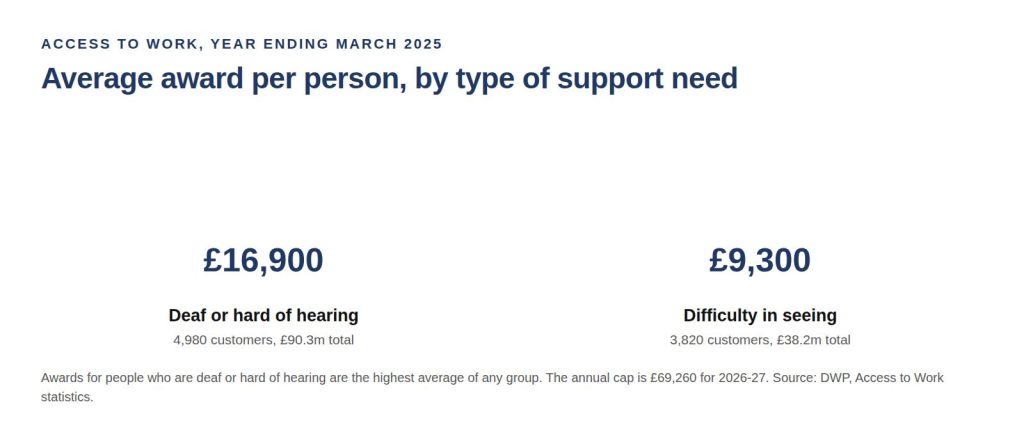
The published statistics show why this scheme matters particularly for sensory loss. In the year ending March 2025, Access to Work approved provision for 56,000 people at a total cost of £320.7 million. Of that, 4,980 customers who were deaf or hard of hearing received £90.3 million, an average of roughly £16,900 per person, which is the highest average award of any group. A further 3,820 customers recorded as having difficulty in seeing received £38.2 million, an average of around £9,300.
Who Can Apply
The eligibility rules published on GOV.UK are:
- You must be 16 or over.
- You must have a disability, illness or health condition that affects your work.
- You must be in paid work, or about to start or return to paid work within the next 12 weeks.
- You must live and work in England, Scotland or Wales. Northern Ireland operates a separate system.
Employment, self-employment, apprenticeships, work trials, work experience, internships and work placements all qualify. Voluntary work does not. Self-employed applicants are eligible but must have an annual turnover of at least £6,500. Civil servants are excluded because their department funds support instead.
The 12-week window before starting a job is the single most useful detail in the whole scheme and is regularly missed. Applying before you start, rather than after, avoids both the delay and, as set out below, any employer contribution.
When the Employer Has to Contribute
Cost sharing applies only in specific circumstances, and it is narrower than most employers expect. It applies only to special aids and equipment and to adaptations to premises or equipment. It does not apply to support workers, travel to work, or the mental health support service, and it does not apply to self-employed applicants at all.
Crucially, cost sharing applies only where the employee has worked for that employer for more than six weeks at the date of the application. A new starter in post six weeks or less attracts no employer contribution whatsoever, which is a strong practical reason to apply as early as possible.
Employer size | Employer pays in full up to | Above that threshold |
0 to 49 employees | Nil | Access to Work refunds up to 80 per cent of approved costs between the threshold and £10,000. |
50 to 249 employees | £500 | Access to Work refunds up to 80 per cent of approved costs between the threshold and £10,000. |
250 or more employees | £1,000 | Access to Work refunds up to 80 per cent of approved costs between the threshold and £10,000. |
Costs above £10,000 are normally met in full by Access to Work.
How to Apply, and How Long It Takes
Applications can be made online through the government’s disability work support service, or by phone on 0800 121 7479. Relay UK and a British Sign Language video relay service are available, and forms can be provided in braille, large print or audio on request. Deaf applicants can ask for all subsequent communication to be by email rather than phone. You will need your National Insurance number, your workplace address, a workplace contact, and a description of how your condition affects your work and what support you need.
Waiting times need to be stated honestly, because they are currently the biggest practical problem with the scheme. The National Audit Office reported in February 2026 that average processing time had risen to 66 days in 2024-25, against 28 days in 2020-21, peaking at 109 days in November 2025. The Public Accounts Committee reported in June 2026 that around 66,000 applications were awaiting a decision as at March 2026, against a 25 working-day target, and that the Access to Work helpline was advising applicants they may have to wait up to 37 weeks.
The Department for Work and Pensions announced in May 2026 that it is recruiting nearly 500 additional case managers and caseworkers, with a target of clearing the backlog by September 2027. It also confirmed that payment delays have been resolved, that 96 per cent of urgent cases are decided within 28 days, and that cases where the applicant starts work within four weeks are prioritised. If you have a start date, say so clearly on the application.
Is Access to Work Changing?
The scheme’s future design is under review. The Pathways to Work green paper published in March 2025 consulted on reform, noting that Access to Work had not been substantially changed since its introduction in 1994, and floated several possible directions including supporting employers directly rather than individuals. The government response published in October 2025 made no firm commitments and stated that it was still considering responses. The Public Accounts Committee confirmed in June 2026 that no decision had yet been made.
So as things stand in August 2026, the current rules apply and nothing has been confirmed to change. It is worth being sceptical of any claim that the scheme is being cut or transferred to employers, because that has been proposed and consulted on, not decided.

Where a Workplace Assessment Fits
A specialist workplace assessment and an Access to Work application are different things, and they work well together. The assessment identifies what a person actually needs in their specific role and environment, produced by an assessor with expertise in sight loss or hearing loss. The Access to Work process decides what the state will fund.
A clear, specific assessment report makes the Access to Work conversation considerably easier, because it sets out what is needed and why. It also helps the employer identify which items are properly their own responsibility as reasonable adjustments, and which fall outside that duty. Given current waiting times, having that clarity before applying is worth a good deal.
Summary
Access to Work is a strong scheme with a serious delay problem. The essential points are these. It does not replace the employer’s duty to make reasonable adjustments, and treating it as though it does will cost months. Apply as early as possible, up to 12 weeks before starting a role, because that avoids both the queue and any employer contribution. The cap is £69,260 for 2026-27. Awards for hearing loss are the largest the scheme makes, averaging around £16,900. And if you have a confirmed start date within four weeks, make sure the application says so, because those cases are prioritised.
If you need a specialist workplace assessment for an employee with sight loss or hearing loss, whether to support an Access to Work application or to identify reasonable adjustments in the first place, visit https://visualisetrainingandconsultancy.com/workplace-assessments to find out more.
Frequently Asked Questions
No. You must be in paid work, or about to start or return to paid work within the next 12 weeks, so an application needs a confirmed start date or an existing job to apply against.
No. A grant does not affect other benefits and does not have to be repaid.
Yes, provided your business has an annual turnover of at least £6,500.
A reasonable adjustment is your employer's legal duty under the Equality Act 2010, and the employer funds it. Access to Work funds support that sits above and beyond that duty, it does not replace it.
Contact the Access to Work helpline for an update, and if you have a confirmed start date within four weeks, make sure this is stated clearly on the application, since those cases are prioritised.
Sources
- UK, Access to Work: https://www.gov.uk/access-to-work
- UK, Access to Work factsheet for customers: https://www.gov.uk/government/publications/access-to-work-factsheet/access-to-work-factsheet-for-customers
- UK, Access to Work factsheet for employers: https://www.gov.uk/government/publications/access-to-work-guide-for-employers/access-to-work-factsheet-for-employers
- UK, Access to Work statistics April 2007 to March 2025: https://www.gov.uk/government/statistics/access-to-work-statistics-april-2007-to-march-2025/access-to-work-statistics-april-2007-to-march-2025
- National Audit Office, the Access to Work scheme, February 2026: https://www.nao.org.uk/press-releases/processing-delays-and-backlogs-in-access-to-work-affect-job-security-and-employer-finances/
- Public Accounts Committee, the Access to Work scheme, June 2026: https://publications.parliament.uk/pa/cm5902/cmselect/cmpubacc/92/report.html
- Acas, reasonable adjustments: https://www.acas.org.uk/reasonable-adjustments