
The scenario in this article is illustrative. It is a composite built from situations that come up often in workplace assessments, and it describes no real person, employer or report. It is here to show how the process works for the people who refer into it.
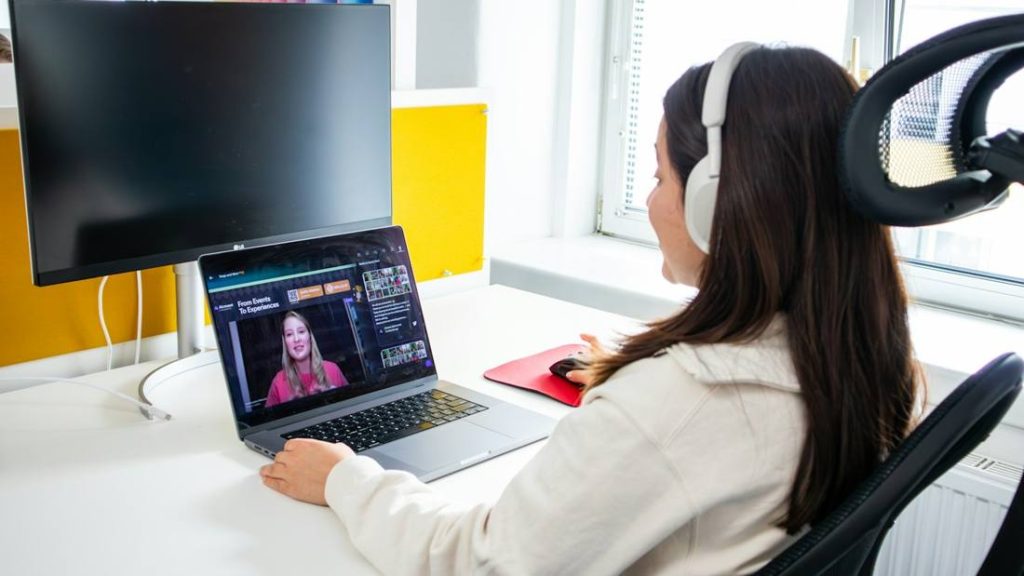
A project coordinator has worn hearing aids for several years. In an office, with a small team and good lighting on faces, she coped well. Then the company moved to hybrid working. Most of her week is now spent in video meetings with people she cannot see clearly, on laptops with poor microphones, in homes with echoing kitchens and barking dogs. She has started to miss decisions. She replies to messages with questions that were answered in the meeting. Her manager has noticed, and so has she. Neither has said so.
She has not asked for help for three reasons that are all common. She does not want to be seen as the person who slows meetings down. She is not sure what she could ask for. And she worries that mentioning it will make people wonder whether she can still do her job.
Why meetings are where it shows
Hearing loss is rarely a simple matter of volume. Many people with hearing loss can hear that someone is speaking and still struggle to make out the words, especially when there is background noise, when several people speak at once, or when the sound is compressed through a laptop speaker. Seeing a speaker’s face and lips helps many people follow speech. Video calls often take that away, through small windows, poor lighting, cameras that are off, and delays between sound and picture.
Listening in these conditions takes sustained concentration, and fatigue builds. Employees with hearing loss often describe a flat tiredness at the end of a day of meetings that colleagues do not share. That fatigue is easy to miss, because from the outside the person simply looks quiet.
How the referral happens
In this scenario, the project coordinator finally tells her line manager after a client meeting in which she answered a question that had not been asked. Her manager, with her agreement, asks HR to arrange a hearing loss workplace assessment. The referral says what is known: her role, that she uses hearing aids, that the difficulty is mainly in video meetings, and what the manager would like to understand. It does not ask for medical opinion.
A referral also helps when it tells the employee what to expect, and presents the assessment as supportive. People who fear judgement are more likely to give a full account when they understand the purpose.
What the assessment involves
The assessment can be carried out by video call or in person. The assessor talks with the project coordinator about her role and her working week: how many meetings she attends, how large they are, which are with clients or suppliers and which are internal, and how much of her work is by phone or call rather than in writing.
The conversation then moves to her hearing at work. This is not a clinical history. It is a practical account of what she can and cannot follow, in which settings, and what she does to cope. In this scenario she explains that she follows conversation best one to one and in quiet rooms, that she relies heavily on lip patterns and facial expressions, that she often cannot tell who is speaking in a group call, and that in a long run of meetings she loses concentration by mid-afternoon. She also describes the equipment she uses: a standard laptop, its built-in speakers and microphone, and a headset that does not work well with her hearing aids.
The assessor looks at the practical set-up as well: her workstation, how audio reaches her, where she takes calls, and what the office and home environments sound like. The assessment does not make a diagnosis, and it does not predict how her hearing may change.
What the report recommends
The report is a workplace adjustments report. It is non-clinical, describes the work and the barriers in functional terms, and sets out recommendations that each stand alone, with a reason tied to something the employee described. Items that need an employer decision are put to the line manager for discussion.
In this scenario, the recommendations might include the following.
| Barrier reported | Possible adjustment | Why it may help |
|---|---|---|
| Headset not working well with her hearing aids | A headset or audio accessory chosen to suit hearing aid users, with features described in the report | May deliver clearer sound directly, reducing the effort of listening |
| Cannot tell who is speaking in group calls | Live captions switched on in meetings, with speaker names shown | May help her follow who said what, and fill gaps in what she hears |
| Relies on lip patterns and expression | An agreement that cameras are on where possible, with good front lighting for speakers | May make speech easier to follow for someone who uses visual cues |
| Several people talking at once | A simple meeting practice: one speaker at a time, the chair indicates who is next, key actions summarised in writing | May cut the confusion that builds when voices overlap |
| Missing points when meetings run long | Agendas and papers sent in advance, and a written summary of decisions afterwards | May allow her to prepare and check what she missed |
| Tiredness at the end of the day | Scheduling breaks between meetings, and not stacking calls back to back where this can be avoided | May reduce listening fatigue |
| Noise at home | A quiet place for calls and use of a headset with a noise-reducing microphone | May improve what she can hear and what others hear from her |
Where equipment needs specific set-up, the report recommends training from the supplier of that product. Meeting practices cost nothing, which is why they matter: they help everyone in the team, not only the person with hearing loss.
What this might change
No adjustment restores hearing, and results vary. What a package of measures can do is reduce the effort of following conversation and give the employee more chance of taking part on equal terms. In this scenario, the realistic aims are fewer missed decisions, less end-of-day fatigue, and an employee who is no longer silently guessing.
For the manager, an equally important outcome is understanding. A colleague who goes quiet in meetings, replies late or asks for things to be repeated may be working hard to hear. Treating that as disengagement makes things worse.
What this means for occupational health, HR and case managers
Referrers can improve what they get from a hearing loss workplace assessment in a few ways. Say what the setting is: meetings, calls, open-plan noise, a particular site. Ask for functional detail, not an audiogram, because the question for the workplace is what the person can follow, not what a test shows. Remember that tinnitus and hearing fatigue are common and are often not mentioned unless someone asks. And encourage the line manager to act on the meeting practices at once, rather than waiting for equipment to arrive.
An assessment does not replace audiology, occupational health advice or any clinical input, and it gives no view on fitness for work.
Legal rights and support
Under the Equality Act 2010, a person is disabled where they have an impairment with a substantial and long-term adverse effect on their ability to carry out normal day-to-day activities. Schedule 1, paragraph 5 means the effect of hearing aids is ignored when deciding whether the definition is met. Where it is met, the employer must make reasonable adjustments. Access to Work, run by the Department for Work and Pensions, can help eligible people in England, Scotland and Wales with things like specialist equipment and communication support, but GOV.UK states that it does not cover reasonable adjustments an employer must legally make. Whether the definition is met for a particular person depends on their circumstances, and this article is general information rather than legal advice.
Summary
In this scenario, nothing was wrong with the project coordinator’s work. The meetings had changed around her. A hearing loss workplace assessment gives her and her employer a shared description of the barriers and a practical list of changes, most of which are simple. The cost of leaving it is the quiet loss of someone who could have stayed fully involved.
Watch the short film
A short film about nodding along in meetings, and what changes when it feels safe to say you missed something.
Frequently Asked Questions
No. It is an illustrative composite, written to show how the assessment process works. It does not describe a real person, employer or report.
It is not required for the workplace assessment, which looks at what the person can follow at work. A test result can be useful context, but the functional account matters more.
Not necessarily. Automatic captions help but are not fully accurate, and some people need them alongside other measures such as clearer audio and good meeting practice.
Yes. The assessment can look at the home set-up as well as the office, because many of the barriers occur in the calls the person takes from home.
If you or someone in your team is deaf or has hearing loss and would like expert, tailored support to stay productive and comfortable at work, visit https://visualisetrainingandconsultancy.com/workplace-assessments/hearing-loss-workplace-assessment/ to arrange a hearing loss workplace assessment.
Sources
RNID, Make your meetings deaf aware: https://rnid.org.uk/employers-and-professionals/accessible-meetings/
RNID, How to use accessibility features on video conferencing apps: https://rnid.org.uk/information-and-support/technology-and-products/video-conferencing-accessibility/
Acas, Reasonable adjustments at work, Having a meeting: https://www.acas.org.uk/reasonable-adjustments/having-a-meeting
GOV.UK, Access to Work: get support if you have a disability or health condition: https://www.gov.uk/access-to-work
GOV.UK, Access to Work, Eligibility: https://www.gov.uk/access-to-work/eligibility
GOV.UK, Definition of disability under the Equality Act 2010: https://www.gov.uk/definition-of-disability-under-equality-act-2010
legislation.gov.uk, Equality Act 2010, Schedule 1, Part 1: https://www.legislation.gov.uk/ukpga/2010/15/schedule/1/part/1
legislation.gov.uk, Equality Act 2010, section 20: https://www.legislation.gov.uk/ukpga/2010/15/section/20