
Most requests for workplace adjustments are agreed without difficulty, particularly where the adjustment costs little. Sometimes they are not. If you have asked for an adjustment because of sight loss or hearing loss and been turned down, this guide sets out what the law actually requires, what an employer can and cannot refuse, and what your options are. It is general information rather than legal advice, and if your situation is serious it is worth taking advice on the specifics.

What the Law Requires
Section 20 of the Equality Act 2010 places a duty on employers to make reasonable adjustments, and it has three parts. The first applies where a provision, criterion or practice puts a disabled person at a substantial disadvantage compared with people who are not disabled. The second applies where a physical feature causes that disadvantage. The third applies where an auxiliary aid would remove the disadvantage, and the Act specifies that an auxiliary aid includes an auxiliary service, which covers British Sign Language interpreters, lipspeakers and note takers.
The Act also states that where the duty relates to information, reasonable steps include making sure the information is provided in an accessible format. That is directly relevant to sight loss and to requests for documents in large print, braille or accessible digital formats.
Under section 21, failing to comply with that duty is discrimination. It is not simply poor practice.
One provision is worth knowing in particular. Section 20(7) states that the employer is not entitled to require the disabled person to pay any part of the cost of complying with the duty. An employee cannot be asked to fund their own reasonable adjustment.
What ‘Reasonable’ Actually Means
The law does not require every adjustment, only reasonable ones. Guidance from the Equality and Human Rights Commission sets out the factors that determine this:
- How effective the change will be in avoiding the disadvantage.
- How practical it is.
- The cost.
- The organisation’s resources and size.
- The availability of financial support.
The EHRC is direct about the low-cost end: if an adjustment costs little or nothing and is not disruptive, it would be reasonable unless some other factor made it unreasonable. For sight loss and hearing loss this covers a great deal of what people ask for, including seating positions, captions on video calls, agendas circulated in advance, adjusted lighting, written confirmation of verbal instructions and flexible working patterns.
The availability of financial support is a listed factor, which means that where Access to Work would meet most of the cost, an argument that the employer cannot afford it becomes considerably weaker.
Can an Employer Refuse on Cost Grounds?
Yes, but only within that reasonableness test, and it is not a general defence. Acas notes that a small employer may not be able to afford as much as a large organisation, and cost can justify refusal where an adjustment would genuinely harm the business. The EHRC guidance points the other way for large employers: where an organisation has substantial financial resources, a significant-cost adjustment is more likely to be reasonable.
Two things an employer cannot do are pass the cost to the employee, which section 20(7) prohibits, and refuse without properly considering the request. Acas is also clear that where a specific adjustment genuinely is unreasonable, the employer should still look for other ways to support the person rather than treating the matter as closed.
Step One: Ask Again, in Writing
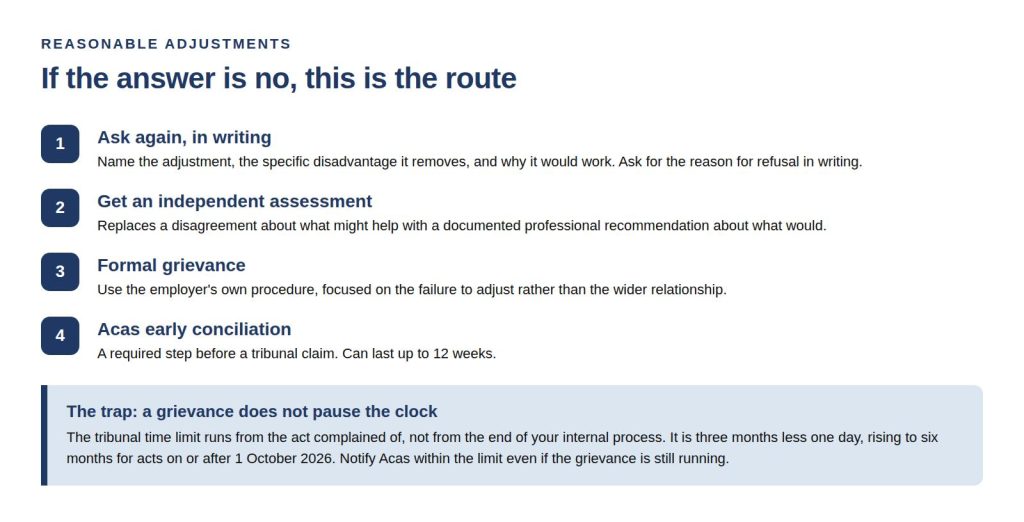
There is no legal requirement for a request to be in writing, but it helps considerably to have a record. If the first request was verbal, put it in writing now, and set out three things: what specifically you are asking for, what difficulty it addresses, and why it would work.
That third point is often what changes the answer. A request framed as a preference is easy to decline. A request framed as a way of removing a specific, identifiable disadvantage is much harder to refuse, and it also tracks the wording of the legal test. If you can point to evidence, such as a workplace assessment report, occupational health advice or a record of the situations where you have been disadvantaged, include it.
It is also worth asking for the reason for the refusal in writing. Employers sometimes decline on the basis of a misunderstanding, for example believing that a cost falls on them when Access to Work would cover it, or that an adjustment is technically impossible when it is not.
Step Two: Get an Independent Assessment
Where an employer is unconvinced, an independent specialist assessment frequently resolves matters without any need for a dispute. It replaces a disagreement between two people about what might help with a documented professional recommendation about what would help, which is a different conversation entirely.
It also tends to clarify cost, because a specialist assessment will usually identify a range of options rather than a single expensive one, and the no-cost options are often the most effective.
Step Three: Raise a Formal Grievance
If informal routes have not worked, the next step is your employer’s formal grievance procedure. Acas advises complaining as soon as possible rather than waiting, and there is a practical reason for that which is explained below.
Keep the grievance focused on the failure to make a reasonable adjustment rather than on the wider relationship, and set out the request, the disadvantage, the refusal and the reason given. Keep copies of everything.
Step Four: Acas Early Conciliation and Tribunal Time Limits
If the grievance does not resolve matters, the formal route is an employment tribunal claim, and before making one you must notify Acas for early conciliation. Taking part in conciliation is voluntary, but notifying Acas is a required step and you need the certificate number to complete the tribunal claim form. Early conciliation can last up to 12 weeks.
Time limits are the trap here, and they are changing, so this needs care. At present the limit is three months less one day from the act complained of, or from the last in a series of acts. However, under the Employment Rights Act 2025, that limit rises to six months for acts occurring on or after 1 October 2026. Acts that occurred entirely before that date keep the three-month limit.
Two points follow from this. First, do not rely on a flat figure of either three or six months, because which applies depends on when the act happened. Second, and more importantly, raising a grievance does not pause the clock. Acas is explicit that raising the problem with your employer does not change the time limits. It is entirely possible to run a grievance process carefully and courteously and find that the deadline has passed while you were doing so. Notify Acas within your time limit even if the internal process is still running.
A Note on Employer Knowledge
The duty to make adjustments applies where the employer knows, or could reasonably be expected to know, that the person has a disability and is likely to be disadvantaged. That second limb matters. An employer cannot simply avoid the duty by not asking, if the circumstances were such that they ought reasonably to have known.
That said, from a practical point of view, making the disadvantage explicit and in writing removes any argument on the point. It is one of the reasons a written request is worth the effort even where a verbal one should have been enough.
Summary
A refusal is not the end of the matter. Put the request in writing, framed around the specific disadvantage it removes rather than as a preference. Ask for the reason for the refusal in writing. Consider an independent specialist assessment, which resolves a great many of these situations by replacing opinion with professional recommendation. If that does not work, use the grievance procedure, and keep the tribunal time limit in view throughout, remembering that a grievance does not pause it and that the limit changes for acts on or after 1 October 2026. Most adjustments for sight loss and hearing loss cost little or nothing, and the EHRC’s own guidance says that low-cost, non-disruptive adjustments will generally be reasonable. That is a strong position to argue from.
If an independent specialist assessment would help demonstrate what support is genuinely needed, visit https://visualisetrainingandconsultancy.com/workplace-assessments to find out how our workplace assessments work.
Frequently Asked Questions
No, there's no legal requirement for it to be in writing, but a written record makes it far easier to pursue later and to use as evidence if the matter escalates.
Only within the reasonableness test. Cost is one factor among several, and larger organisations with greater resources are expected to absorb more of it. What an employer cannot do is pass the cost on to you.
In almost all cases a tribunal will not hear a claim brought after the time limit has passed, which is why notifying Acas for early conciliation promptly matters, even while an internal grievance is still running.
Often, yes. It replaces two people's differing opinions about what might help with a documented, professional recommendation, which resolves a large proportion of these situations without the need for a formal grievance.
Sources
- Equality Act 2010, section 20: https://www.legislation.gov.uk/ukpga/2010/15/section/20
- Equality Act 2010, section 21: https://www.legislation.gov.uk/ukpga/2010/15/section/21
- EHRC, what do we mean by reasonable: https://www.equalityhumanrights.com/guidance/business/employing-people-workplace-adjustments/what-do-we-mean-reasonable
- Acas, reasonable adjustments: https://www.acas.org.uk/reasonable-adjustments
- Acas, employment tribunal time limits: https://www.acas.org.uk/employment-tribunal-time-limits
- Acas, early conciliation: https://www.acas.org.uk/early-conciliation
- Acas, Employment Rights Act 2025: https://www.acas.org.uk/employment-rights-act-2025