
Ménière’s disease presents an employer with a different problem from most hearing conditions. The hearing loss matters, but the harder issue is unpredictability. Someone can be entirely well at nine o’clock and unable to stand up at eleven, then be fine again the following day. Planning for that is what good support looks like.
About Ménière’s Disease
Ménière’s disease is a condition of the inner ear. The NHS describes the main symptoms as vertigo, where you or everything around you feels like it is spinning, loss of balance, tinnitus, hearing loss, and a feeling of pressure or discomfort deep inside the ear. Nausea and vomiting are common during an attack.
Attacks are episodic rather than constant. The NHS states they can last anywhere between a few minutes and 24 hours, while the clinical diagnostic criteria used by specialists describe vertigo attacks lasting between 20 minutes and 12 hours. Between attacks a person may be entirely symptom-free, and periods of remission can last months.
A 2015 study carried out with the Ménière’s Society estimated that approximately 120,000 people in the UK are diagnosed with the condition. The NHS describes it simply as a rare inner ear condition without giving a figure. Onset is typically in working age, most commonly between the twenties and sixties, which is precisely why it turns up as a workplace issue rather than a retirement one.
Usually only one ear is affected, although up to half of those affected may develop the condition in both ears, often years later. The hearing loss initially fluctuates but tends to become permanent over time. It is classically a low-frequency loss, which is the opposite pattern to age-related or noise-induced hearing loss, and it is one reason a person may report that their hearing genuinely changes from week to week.
How Ménière’s Disease Can Affect Work
The evidence on this is stark. Research published in the British Journal of General Practice in 2021 reported that 86 per cent of patients found their job performance suffered as a result of their Ménière’s, and 70 per cent had to modify their work in some way.
An acute attack makes work impossible for its duration and often leaves the person drained afterwards. Beyond the attacks themselves, the anticipation is its own burden. Research with people who have the condition described it as being like waves on a shore, with the larger ones arriving without warning, and that uncertainty creates persistent anxiety about being caught out at work, on a client site or while driving.
The fluctuating hearing loss adds a further layer, because a person may follow a meeting comfortably one week and struggle the next, which colleagues can misread as inattention.
Driving and Safety-Critical Work
This needs stating plainly because it is a legal duty rather than a matter of preference. The NHS advises that you must tell the DVLA if you have dizziness that comes on suddenly or happens often, and GOV.UK confirms that you must notify the DVLA if you experience dizziness that is sudden, disabling or recurrent. The relevant standard concerns episodes that arrive without sufficient warning to allow safe evasive action. Group 2 licence holders, meaning bus and lorry drivers, face stricter requirements than car and motorcycle drivers.
For work at height, on ladders, around moving machinery or in other safety-critical settings, no condition-specific published guidance exists that we are aware of. The sensible approach is to apply the same logic the DVLA uses, and ask whether an attack could arrive without enough warning for the person to make themselves safe. That is a question for occupational health and a risk assessment rather than for a line manager alone, and it should be revisited as the condition changes rather than decided once.
No-Cost and Low-Cost Workplace Adjustments
Area | Suggested adjustment | Why it helps |
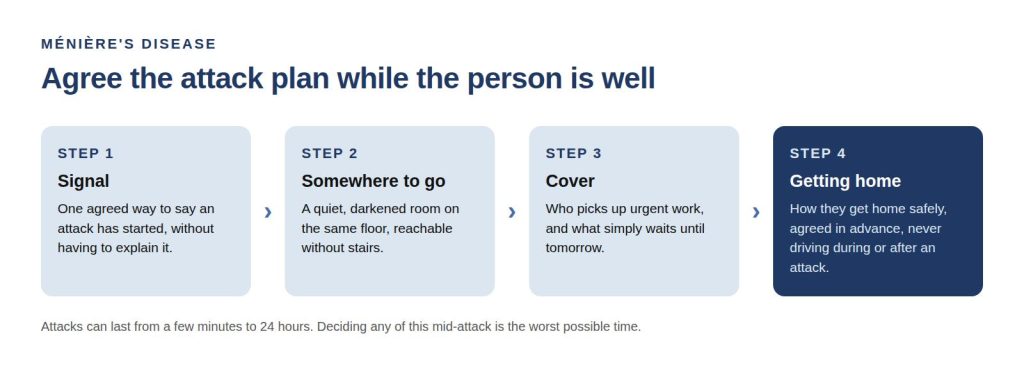
Attack planning | Agree in advance where the person can go, who they tell, and what happens to their work when an attack starts. | Removes the need to negotiate anything while acutely unwell, which is the worst possible moment. |
Quiet space | Provide access to a quiet, darkened room where the person can wait out an attack safely. | Attacks often pass in under a couple of hours, so a place to wait can prevent a lost day. |
Location | Desk space on the ground floor or with lift access, and facilities on the same floor. | Stairs are a particular hazard during or after an episode. |
Environment | Avoid strongly patterned carpets and wall coverings, and flickering or fluorescent lighting where possible. | Visual patterns and flicker can aggravate dizziness. |
Working patterns | Flexible hours, the option to work from home, and flexible leave arrangements for attacks and recovery. | Matches support to a condition that is episodic rather than constant. |
Meetings | Allow remote attendance as standard, and share written notes. | Removes travel risk and covers the fluctuating hearing loss at the same time. |
Fire alarms | Give advance notice of alarm tests, and provide visual alarm indicators. | Sudden loud noise can trigger or worsen symptoms, and the person may need longer to evacuate. |
Absence policy | Review how absence triggers apply, given the episodic pattern. | Standard absence thresholds can penalise a condition that comes in unpredictable clusters. |
Hints and Tips for Everyday Working
- Agree an attack plan with your manager while you are well, not during an episode.
- Keep whatever you need for an attack at work as well as at home, so you are never caught without it.
- Schedule demanding or client-facing work for periods when you have been stable, where the diary allows it.
- Tell the DVLA if your dizziness is sudden, disabling or recurrent, and tell your insurer too.
- Ask for meeting notes as standard, so a missed meeting does not become a missed decision.
- Keep a simple record of attacks, including timing and possible triggers, which helps both your clinician and any adjustment discussion.
Building Awareness and Communication
Colleagues generally understand deafness and generally understand dizziness. What they find harder is a condition that produces neither symptom on most days and both on some. The employee is frequently well, which makes the bad days look inconsistent rather than medical.
An agreed, brief explanation to the immediate team, on the employee’s terms, tends to prevent that misreading. Research with people who have Ménière’s found that the employer’s response influenced whether people stayed in paid work at all, which puts the value of getting this right into perspective. Where the role involves driving, height or machinery, occupational health should be involved early rather than after an incident.
Where colleagues would benefit from a broader understanding of fluctuating and invisible hearing conditions, our hearing loss awareness e-learning is a straightforward way to build that understanding.
Legal Rights and Support
Under the Equality Act 2010, a condition counts as a disability where it has a substantial and long-term adverse effect on normal day-to-day activities. A condition that fluctuates or recurs can still meet that test, and Ménière’s frequently will. Where it does, the employer has a duty to make reasonable adjustments, which in practice tends to mean flexibility and planning rather than equipment.
Summary
Ménière’s disease is unusual among hearing conditions in that the most valuable adjustments are procedural rather than physical. An agreed plan for what happens when an attack starts, a quiet room, flexibility over hours and location, and a sensible view of absence triggers will do more than any piece of equipment. The hearing loss should not be forgotten, since it fluctuates and eventually becomes permanent, but it is the unpredictability that determines whether someone can stay in their job. With 86 per cent of people reporting that their job performance suffers, this is a condition where an employer’s response genuinely decides the outcome.
If you or someone in your team is deaf or has hearing loss and would like expert, tailored support to stay productive and comfortable at work, visit https://visualisetrainingandconsultancy.com/workplace-assessments/hearing-loss-workplace-assessment/ to arrange a hearing loss workplace assessment.
Frequently Asked Questions
Yes, if your dizziness is sudden, disabling or recurrent you must notify the DVLA, and Group 2 licence holders (bus and lorry drivers) face stricter requirements than car and motorcycle drivers.
This varies a great deal from person to person, which is exactly why it's hard to plan around. An agreed plan for what happens when an attack starts, decided while you are well, is the most effective preparation available.
That's your choice, but research has found that an agreed, brief explanation to the immediate team tends to prevent bad days being misread as inconsistency, and that an employer's response influences whether people stay in paid work at all.
Sources
- NHS, Ménière’s disease: https://www.nhs.uk/conditions/menieres-disease/
- Ménière’s and Vestibular UK, information for employers: https://www.meandve.org.uk/information-and-support/day-to-day/information-for-employers
- Ménière’s disease: management in primary care, British Journal of General Practice, 2021: https://bjgp.org/content/71/713/571
- UK, dizziness and driving: https://www.gov.uk/dizziness-and-driving
- European Centre for Environment and Human Health, Ménière’s key findings, 2015: https://www.ecehh.org/wp/wp-content/uploads/2015/01/M%C3%A9ni%C3%A8re%E2%80%99s-key-findings.pdf