
Age-related hearing loss is the most common cause of hearing loss, and with people working later in life it is now firmly a workplace issue rather than a retirement one. It also has a particular characteristic that shapes everything about how employers should handle it: it arrives so gradually that most people do not recognise it, and RNID states that on average people wait ten years before seeking help.
About Age-Related Hearing Loss
Age-related hearing loss, known clinically as presbycusis, is caused by changes that happen over time to the inner ear. RNID describes it as the most common cause of hearing loss, notes that it tends to affect both ears, and confirms that there is currently no way to restore hearing once it has occurred.
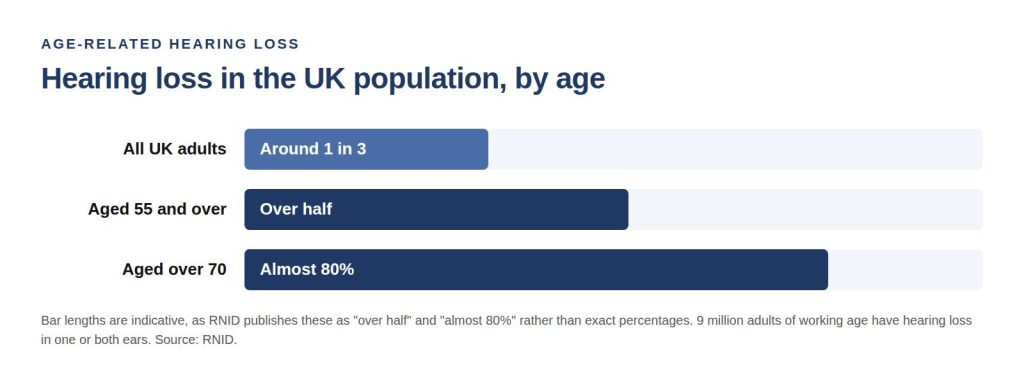
The scale is larger than most employers assume. RNID states that over 18 million adults in the UK are deaf, have hearing loss or tinnitus, which is around one in three adults. That figure was revised upwards in 2024 following analysis using 2021 and 2022 census data, so anyone working from an older figure of around 12 million is out of date. More directly relevant to employers, RNID estimates that 9 million adults of working age have hearing loss in one or both ears.
Prevalence rises sharply with age. RNID states that over half the population aged 55 or more have hearing loss, and that almost 80 per cent of people over 70 will have hearing loss. Given current working patterns, a significant proportion of any experienced workforce is affected.
The pattern of loss explains why it goes unrecognised for so long. Higher-pitched sounds are affected first, so speech remains audible while becoming less clear, and the person concludes that other people are mumbling rather than that their hearing has changed. RNID identifies difficulty understanding what is being said in noisy places as a key warning sign.
How Age-Related Hearing Loss Can Affect Work
Because the loss is gradual, the workplace effects tend to be attributed to something else first. A person may be described as distracted, disengaged or slowing down, when in fact they are missing perhaps a fifth of what is said in a busy meeting and reconstructing the rest from context. That is exhausting, and it becomes more so as the day goes on.
Telephone calls, open-plan offices, video calls with poor audio and group discussions are the common difficulties. Confidence is frequently affected before performance is, and many people withdraw from meetings or social contact at work rather than disclose. RNID research found that 42 per cent of people surveyed did not try to seek support for their hearing loss or deafness at work.
The employment effects are measurable. ONS figures cited by RNID show an employment rate of 74.7 per cent for those who selected difficulty in hearing as their main condition, against 82.5 per cent for non-disabled people.
No-Cost and Low-Cost Workplace Adjustments
Area | Suggested adjustment | Why it helps |
Meetings | One person speaks at a time, the chair repeats questions, and an agenda goes out in advance. | Advance context does much of the work that clear hearing would otherwise do. |
Meetings | Turn on live captions in Teams or Zoom as standard for all meetings. | Free, already built in, and removes the need for anyone to ask for it. |
Rooms | Choose smaller rooms with carpet and soft furnishings over large, hard-surfaced spaces. | Reverberation is often more disabling than volume. |
Lighting | Make sure the speaker’s face is well lit and visible. | Most people lip read to some extent without being aware of it. |
Telephony | Offer an amplified handset, a headset, or a move to email and messaging where the role allows. | The telephone is the most commonly reported difficulty and often the easiest to work around. |
Written follow-up | Confirm decisions and actions in writing after meetings as a matter of routine. | Protects against a misheard detail becoming a mistake. |
Open plan | Offer a desk away from the busiest area, or access to a quiet room for calls and concentrated work. | Background noise is the single biggest barrier to speech understanding. |
Culture | Normalise asking for repetition, starting with senior staff. | Reduces the disclosure barrier that keeps 42 per cent of people from asking for support. |
Hints and Tips for Everyday Working
- If you find yourself thinking that everyone has started mumbling, consider a hearing check. That is the classic first sign.
- Ask for agendas in advance, since knowing the topic makes unfamiliar words far easier to catch.
- Sit where you can see faces and away from air conditioning, printers and open doors.
- Turn captions on for every video call rather than only the difficult ones.
- Repeat back what you have understood at the end of a conversation, which catches errors without requiring you to disclose anything.
- Do not wait ten years. Earlier support means less time spent compensating and less fatigue.
Building Awareness and Communication
The distinctive challenge here is disclosure. Age-related hearing loss carries an association with getting older that people are often reluctant to accept, particularly at work and particularly where they are concerned about how it might affect their standing or their prospects. The result is that employers usually find out late.
The most effective response is not a policy about hearing loss but a set of meeting habits that make disclosure unnecessary. If captions are on by default, agendas circulate in advance, one person speaks at a time and decisions are confirmed in writing, a large proportion of the difficulty disappears without anyone having to say anything. Those who then do want specific support are far more likely to ask, because the culture has already shown it will be met sensibly.
Where the wider team would benefit from a fuller understanding of hearing loss generally, our hearing loss awareness e-learning is a practical way to build it.
Legal Rights and Support
Under the Equality Act 2010, a condition is a disability where it has a substantial and long-term adverse effect on a person’s ability to carry out normal day-to-day activities. Age-related hearing loss is permanent and progressive, so where the effect is substantial the duty to make reasonable adjustments applies. As with other hearing conditions, the adjustments that make the most difference are usually free, which makes the reasonableness question straightforward in most cases.
Summary
With 9 million adults of working age affected, age-related hearing loss is not a niche consideration. It is gradual, it is under-reported, and it is frequently misread as disengagement rather than a hearing difficulty. The practical answer is largely cultural: captions by default, agendas in advance, one voice at a time, and written confirmation of what was decided. Those changes cost nothing, they help everyone in the room, and crucially they support the large number of people who have not told you and may not yet have told themselves.
If you or someone in your team is deaf or has hearing loss and would like expert, tailored support to stay productive and comfortable at work, visit https://visualisetrainingandconsultancy.com/workplace-assessments/hearing-loss-workplace-assessment/ to arrange a hearing loss workplace assessment.
Frequently Asked Questions
Book a hearing check as soon as possible. RNID notes that people typically wait around ten years before seeking help, and the longer that gap runs, the more energy gets spent compensating.
No, but disclosing allows your employer to make reasonable adjustments, and the Equality Act 2010 duty applies once they know, or could reasonably be expected to know.
Often not on their own. Hearing aids help, but background noise, poor room acoustics and meeting habits often matter just as much, which is why workplace-level changes complement rather than replace them.
Sources
- RNID, prevalence of deafness and hearing loss: https://rnid.org.uk/get-involved/research-and-policy/facts-and-figures/prevalence-of-deafness-and-hearing-loss/
- RNID, age-related hearing loss: https://rnid.org.uk/information-and-support/hearing-loss/types-of-hearing-loss-and-deafness/age-related-hearing-loss/
- RNID, facts and statements on employment: https://rnid.org.uk/get-involved/research-and-policy/facts-and-figures/facts-and-statements-on-employment/
- RNID, why the number of people with hearing loss has increased, June 2024: https://rnid.org.uk/2024/06/why-the-number-of-people-with-hearing-loss-has-increased/