
If you have been told you are having a workplace assessment, or you are an employer arranging one for the first time, it is reasonable to want to know what it involves before it happens. This guide walks through the process for a specialist sight loss or hearing loss assessment from referral to report, and explains what each stage is actually for.
What a Workplace Assessment Is
A workplace assessment looks at one person, in one job, in their actual working environment, and identifies what would help them do that job without unnecessary barriers. It is not a medical assessment and it does not judge whether someone is fit for work. It does not test anyone’s competence.
A specialist sensory assessment differs from a general workstation or display screen equipment assessment in an important way. A standard DSE assessment considers posture, screen height and chair position. It rarely considers whether the person can actually read the screen, whether magnification software is configured correctly, whether the lighting is creating glare that makes a monitor unusable, or whether someone can follow a briefing in a room with hard surfaces. Those questions require an assessor who works with sight loss and hearing loss specifically.
Step One: The Referral
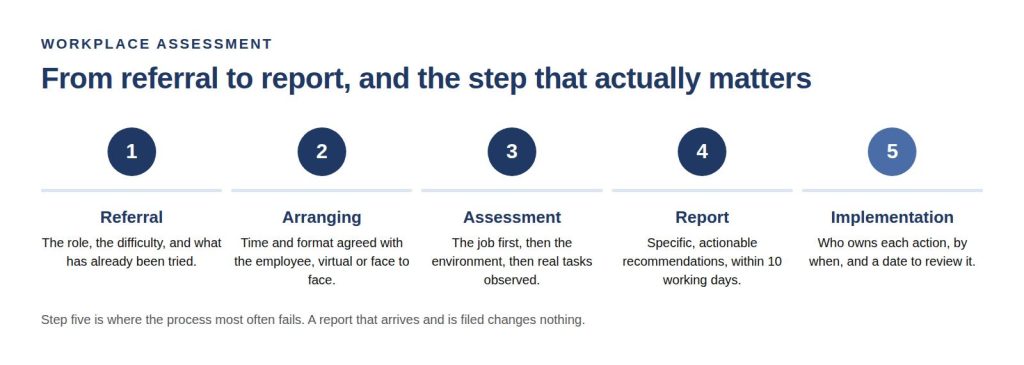
An assessment is usually requested by an employer, an HR or occupational health team, a case manager, or the employee themselves. The referral sets out the basics: who the employee is, what their role involves, what is currently difficult, and whether there is a deadline such as a return-to-work date or a start date.
It is helpful at this stage to say what has already been tried. An assessment that duplicates six months of work someone has already done is a waste of everyone’s time, whereas one that starts from what has and has not worked is far more useful.
Step Two: Arranging It
The assessor contacts the employee directly to arrange a time. This matters more than it might appear. The assessment works best when the employee has a say in when and how it happens, and when they understand from the outset that the conversation is confidential to the process rather than a performance review.
Assessments can be carried out virtually or face to face. Face to face is generally preferable where the physical environment is central to the difficulty, for example lighting, acoustics, site safety or navigating a building. A virtual assessment can work well where the issues centre on software, screen access or communication practice, and it is often quicker to arrange.
Step Three: The Assessment Itself
The assessment usually starts with a conversation about the job rather than about the condition. What does a normal day look like, what are the tasks that matter most, where does it go wrong, and what workarounds has the person already invented? Most employees have developed a set of coping strategies that nobody has ever asked them about, and those strategies tell an assessor a great deal.
For sight loss, the assessor will typically look at how the person accesses screen-based information, what magnification or screen reading software is in place and whether it is set up properly, lighting and glare, contrast, printed material, and safe movement around the building. For hearing loss, the focus is more likely to be on communication in meetings and on the phone, the acoustics of the spaces the person works in, background noise, assistive listening technology, and whether alarms and warning signals can actually be heard.
The assessor will also observe the person doing real tasks where that is practical. There is often a considerable gap between how a job is described and how it is actually performed, and that gap is usually where the useful findings are.