
Tinnitus is one of the most common hearing conditions in the UK, yet many people living with it continue to work successfully in every kind of role and sector. With a little understanding and a few practical adjustments, most of the barriers it creates at work can be reduced considerably, and usually at little or no cost.
About Tinnitus
Tinnitus is the perception of sound that has no external source. People describe it in different ways, most commonly as ringing, buzzing, hissing, whistling or humming, and for some it has a pulsing quality that follows their heartbeat. It may be heard in one ear, in both, or as though it is coming from inside the head. For some people it is constant, and for others it comes and goes.
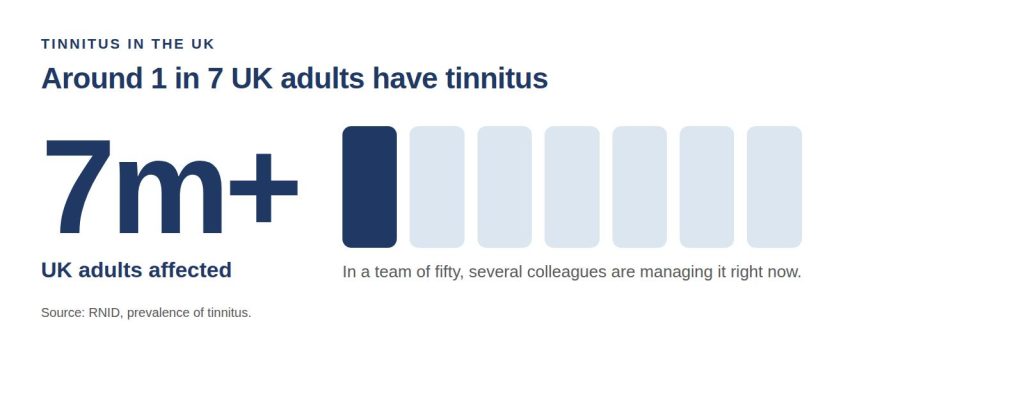
According to RNID, around 1 in 7 adults in the UK have tinnitus, which amounts to more than 7 million people. It is far more common than most workplaces realise, and any organisation of reasonable size is very likely to employ several people who experience it.
Tinnitus is often, though not always, linked to some degree of hearing loss. It can follow exposure to loud noise, whether through work, music or a single acute incident, and it is also associated with ear infections, some medications, head injuries and age-related changes to hearing. In many cases no single cause is ever identified.
What matters most from a workplace point of view is that the experience varies enormously from one person to the next. Some people are barely aware of their tinnitus for most of the day. Others find it intrusive and exhausting. It commonly fluctuates, becoming more noticeable when someone is tired, stressed, unwell or sitting in a very quiet room. Two colleagues with the same diagnosis may need quite different support, which is why a conversation matters more than an assumption.
How Tinnitus Can Affect Work
The difficulty reported most often is concentration, particularly on detailed work that needs sustained attention. Following conversations can also be harder, especially in open-plan offices, on busy sites, or in meetings where several people speak at once. Where tinnitus occurs alongside hearing loss, the effort involved in listening across a full working day can be genuinely tiring.
Sleep is another common issue, since tinnitus is often at its most noticeable at night, and disrupted sleep affects performance the following day. Pressure and stress tend to make symptoms worse, which in turn creates more stress, and that cycle can be hard to break without support. None of this is inevitable. Sensible adjustments reduce the impact substantially.
No-Cost and Low-Cost Workplace Adjustments
The adjustments below cost little or nothing to put in place, and most can be arranged by a line manager without a formal process.
Area | Suggested adjustment | Why it helps |
Sound environment | Offer a desk position away from printers, walkways, air-conditioning units and busy thoroughfares. | Reduces competing background noise and lowers daily listening effort. |
Sound environment | Allow low-level background sound, such as a small desk fan or a sound app through headphones. | Gentle constant sound often makes tinnitus less noticeable than silence. |
Meetings | Book smaller, quieter rooms and avoid spaces with hard, echoing surfaces. | Less reverberation makes speech easier to follow. |
Meetings | Ask people to speak one at a time, and share agendas and written notes. | Reduces the effort of separating voices and provides a fallback record. |
Meetings | Switch on live captions in Teams or Zoom. | Already built into most platforms at no additional cost. |
Workspace layout | Provide access to a bookable quiet room for tasks needing deep concentration. | Gives a reliable option on days when symptoms are more intrusive. |
Working patterns | Allow short, regular breaks away from noise, and flexible start times after disturbed nights. | Helps manage fatigue and prevents symptoms building through the day. |
Information access | Put key instructions in writing rather than relying on verbal briefings alone. | Removes the risk of detail being missed and reduces anxiety. |
Wellbeing | Signpost occupational health and employee assistance early, and review workload during flare-ups. | Breaks the cycle in which stress worsens tinnitus and tinnitus worsens stress. |
Hints and Tips for Everyday Working
- Tackle the most demanding tasks at the time of day when symptoms tend to be quietest, which for many people is earlier in the morning.
- Use headphones with low-level background sound rather than working in complete silence, as silence often makes tinnitus more prominent.
- Agree a simple signal with close colleagues for days when symptoms are worse, so support does not depend on explaining it each time.
- Ask for written confirmation of decisions made verbally, particularly after busy meetings.
- Build short breaks away from noise into the day rather than waiting until fatigue has already set in.
- Keep a brief note of what makes symptoms better or worse at work, as patterns are useful evidence when requesting adjustments.
Building Awareness and Communication
Tinnitus is invisible, and colleagues who cannot see a condition often underestimate its effect. Many people say the hardest part is not the sound itself but explaining it repeatedly to people who assume it is a minor irritation.
Open conversation makes the difference. A short, regular check-in between an employee and their manager, focused on what is working rather than on the diagnosis, tends to be far more useful than a one-off formal discussion. Awareness training for the wider team helps too, particularly where colleagues share a noisy environment, because small changes in how a team communicates often benefit everyone. Where the picture is more complex, a specialist workplace assessment will identify practical adjustments that neither the employee nor the employer had considered.
Our deaf and hearing loss awareness e-learning is worth considering for the wider team.
Legal Rights and Support
Under the Equality Act 2010, a condition is treated as a disability where it has a substantial and long-term adverse effect on a person’s ability to carry out normal day-to-day activities. Tinnitus can meet that definition, although it depends on the effect on the individual rather than on the diagnosis alone. Where it does, the employer has a duty to make reasonable adjustments. In practice, most of the adjustments that help are inexpensive and straightforward, so it is rarely worth waiting for a formal determination before acting.
Summary
Tinnitus affects more than 7 million adults in the UK, and a great many of them are at work today, managing well and saying nothing about it. The condition fluctuates, it is invisible, and its impact is easy to underestimate from the outside. The good news for employers is that the adjustments which make the biggest difference, quieter spaces, written information, captions on calls, flexibility around fatigue, cost almost nothing and tend to improve working life for the whole team. What is needed first is simply a conversation, held early and without assumptions, about what would actually help.
Frequently Asked Questions
It can be, if it has a substantial and long-term adverse effect on day-to-day activities, though this depends on the individual rather than the diagnosis alone.
Often, but not always. Tinnitus can occur without measurable hearing loss, and the two should be assessed separately.
Concentration, particularly on detailed work that needs sustained attention, along with disrupted sleep that affects the following day's performance.
If you or someone in your team is deaf or has hearing loss or tinnitus and would like expert, tailored support to stay productive and comfortable at work, visit https://visualisetrainingandconsultancy.com/workplace-assessments/hearing-loss-workplace-assessment/ to arrange a hearing loss workplace assessment.