
Single-sided deafness is one of the most misunderstood forms of hearing loss at work, largely because the person can hear. They can hold a conversation, take a call and follow a meeting, so colleagues reasonably assume there is no difficulty. The difficulty is real, and it is mostly about where sound is coming from and what else is going on in the room.
About Single-Sided Deafness
RNID describes single-sided deafness as having little or no hearing in one ear while the other ear hears normally or has only mild hearing loss. It may be present from birth or acquired later, and common causes include sudden hearing loss in one ear, acoustic neuroma, Ménière’s disease, severe ear infections and head injury. In a proportion of cases no cause is ever identified.
It is worth being honest about the numbers here. NHS England states that the prevalence of adult unilateral hearing impairment in the UK is unknown. Figures do circulate, but they vary so widely between sources that none of them can be relied on, and we would rather say so than quote something that looks authoritative and is not.
What is well established is the functional effect. Hearing with two ears is not simply hearing twice as loudly. The brain compares the timing and loudness of sound arriving at each ear to work out direction, and it uses the difference between the two ears to separate a voice from background noise. With one ear, both of those abilities are substantially reduced.
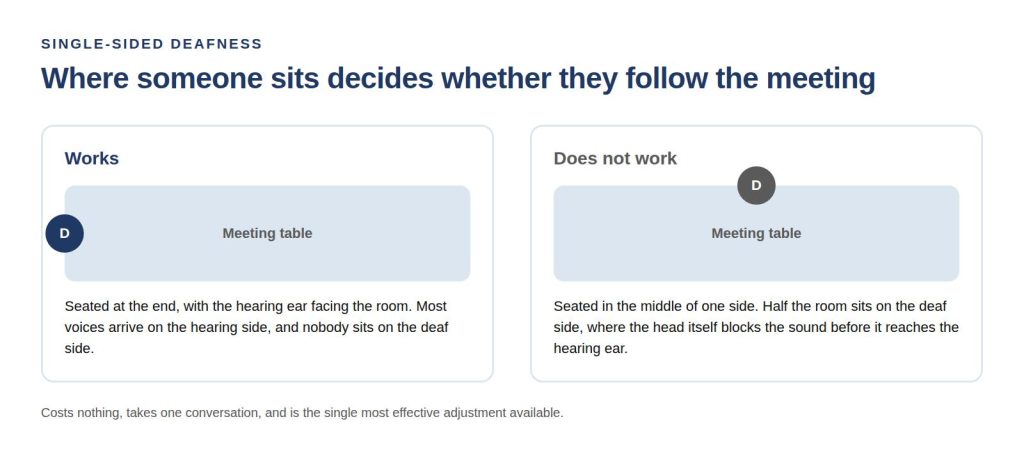
There is also the head shadow effect. The head itself blocks sound coming from the deaf side, so a voice on that side arrives at the hearing ear noticeably quieter than it would otherwise. In practice this means the same conversation can be comfortable or nearly impossible depending purely on which side the speaker is standing.
How Single-Sided Deafness Can Affect Work
Analysis of UK Biobank data published in Ear and Hearing in 2021 found that adults who could hear in only one ear had substantially raised odds of difficulty following conversations in background noise compared with people with normal hearing in both ears. That single finding explains most of what happens at work.
Open-plan offices, busy sites, meetings with several speakers, hospitality floors and vehicles are all environments where a person with single-sided deafness works considerably harder than the colleague next to them for the same result. Seating position in a meeting can determine whether they follow it or not. Group conversations where people speak over one another are particularly difficult, because the usual strategy of turning the hearing ear towards the speaker only works when there is one speaker.
The same study found raised odds of loneliness and of reporting poor health, which is a useful corrective to the assumption that one good ear is enough. Sound localisation is the other practical issue, and it has a safety dimension in any environment with moving vehicles, plant or alarms.
No-Cost and Low-Cost Workplace Adjustments
Area | Suggested adjustment | Why it helps |
Seating | Let the person choose their seat in meetings, and keep it consistent, so their hearing ear faces the room. | The single most effective adjustment available, and it costs nothing. |
Desk position | Position the desk so colleagues approach on the hearing side, and so the deaf ear faces a wall rather than the room. | Reduces both missed approaches and competing noise. |
Meetings | One person speaks at a time, and the chair repeats questions asked from the floor. | Removes the need to separate overlapping voices, which binaural hearing normally does automatically. |
Meetings | Book smaller rooms with soft furnishings and use live captions on video calls. | Less reverberation, and a written fallback at no cost. |
Telephony | Allow a headset that can be worn on the preferred side, or move to messaging and video where the role allows. | Handsets and shared phones often force the wrong ear. |
Site safety | Review walking routes, vehicle movements and alarm placement, considering that direction of sound cannot be judged reliably. | Localisation loss is a genuine safety factor, not a comfort issue. |
Working patterns | Allow quiet space for concentrated work and short breaks away from noise. | Reduces the fatigue that builds from sustained listening effort. |
Hints and Tips for Everyday Working
- Tell colleagues which is your hearing side. Most people will simply move, and are glad to be told.
- Arrive early to meetings so you can choose where to sit rather than taking the last free chair.
- In a group, position yourself at the end of a table rather than the middle, so most voices come from one side.
- Ask for questions from the floor to be repeated by the chair rather than trying to catch them from behind you.
- In a noisy setting, suggest moving rather than persevering. It is faster than asking for three repetitions.
- Be aware that you may not hear something approaching on your deaf side, and build that into how you move around a site.
Building Awareness and Communication
The awareness problem with single-sided deafness is specific: because the person manages well one to one in a quiet room, colleagues conclude there is no real issue and stop making the small accommodations that were actually doing the work. It is worth explaining that the difficulty is situational rather than constant, and that this is why the same person can chair a meeting confidently one day and miss half a conversation in a canteen the next.
A short conversation at team level, agreed with the employee, usually resolves more than any policy. Where the environment is complex, a specialist workplace assessment will look at seating, acoustics, telephony and safety routes together rather than in isolation.
Where the environment is more complex than a single conversation can resolve, our deaf and hearing loss awareness e-learning is a useful next step for the wider team.
Legal Rights and Support
Under the Equality Act 2010, a condition is a disability where it has a substantial and long-term adverse effect on normal day-to-day activities. Single-sided deafness can meet that definition, though it depends on the effect on the individual rather than the diagnosis alone. Where it does, the employer has a duty to make reasonable adjustments. Given that the most effective adjustments here are seating, meeting practice and communication habits, the cost argument rarely arises.
Summary
Single-sided deafness is easy to overlook and cheap to accommodate, which is an unusual and rather favourable combination. The person is not asking for equipment in most cases. They are asking to sit on a particular side, for one person to speak at a time, and for questions to be repeated. Those changes cost nothing, take effect immediately, and tend to improve meetings for everyone in the room. Where the working environment involves vehicles, plant or alarms, the loss of sound localisation deserves a proper look as a safety matter as well.
If you or someone in your team is deaf or has hearing loss and would like expert, tailored support to stay productive and comfortable at work, visit https://visualisetrainingandconsultancy.com/workplace-assessments/hearing-loss-workplace-assessment/ to arrange a hearing loss workplace assessment.
Frequently Asked Questions
It can be, depending on the effect on the individual rather than the diagnosis alone. Where the effect is substantial and long-term, the duty to make reasonable adjustments applies.
Two ears work together to separate speech from background noise and to judge direction. With only one working ear, both of those abilities are reduced, which is why group settings are harder than quiet one-to-one conversations.
Seating position. Choosing where you sit relative to speakers and noise sources costs nothing and often resolves most of the day-to-day difficulty.
Sources
- RNID, single-sided deafness: https://rnid.org.uk/information-and-support/hearing-loss/types-of-hearing-loss-and-deafness/single-sided-deafness/
- NHS England, clinical commissioning policy on bone conducting hearing implants (prevalence unknown): https://www.england.nhs.uk/commissioning/wp-content/uploads/sites/12/2013/05/16041_FINAL.pdf
- Pierzycki et al., associations between hearing health and well-being in unilateral hearing impairment, Ear and Hearing, 2021: https://www.ukbiobank.ac.uk/publications/associations-between-hearing-health-and-well-being-in-unilateral-hearing-impairment/