
Noise-induced hearing loss is entirely preventable, and entirely permanent once it has happened. It remains one of the most common occupational health conditions in Great Britain, yet many of the workplace adjustments that help someone who already has it cost little or nothing to put in place.
About Noise-Induced Hearing Loss
Noise-induced hearing loss is damage to the inner ear caused by exposure to loud sound. It usually develops gradually over years of exposure, although a single very loud or explosive noise can cause immediate and lasting damage.
HSE estimates that around 15,000 people each year have hearing problems caused or made worse by their work, based on Labour Force Survey data averaged over 2022/23 to 2024/25. The confidence interval around that estimate is wide, at 8,000 to 21,000, so it is best treated as an indication of scale rather than a precise count. HSE separately estimates that more than two million people in Great Britain are exposed to unacceptable levels of noise at work.
The damage is not recoverable. HSE is unambiguous on this point: hearing damage caused by exposure to noise at work is permanent and incurable. Hearing aids can help a person make better use of the hearing they still have, but they do not restore what has been lost.
The pattern of loss matters for work. RNID explains that noise damage typically shows first as a dip in the higher frequencies, and if exposure continues, that dip spreads to affect lower frequencies too. Because consonants sit in the higher frequencies, speech can still sound loud enough while remaining difficult to make out, particularly against background noise. Tinnitus often accompanies the loss, and for some people it is the first sign that damage has occurred.
Higher-risk work identified by HSE includes construction, demolition and road repair, woodworking, plastics processing, engineering, textile manufacture, general fabrication, forging and stamping, paper or board making, canning and bottling, foundries, and waste and recycling.
How Noise-Induced Hearing Loss Can Affect Work
The most immediate difficulty is following speech, especially where several people are talking, where there is machinery running, or on the telephone. Toolbox talks, briefings delivered on a noisy site and instructions shouted across a workshop are all common failure points.
There is a safety dimension too. Warning signals, reversing alarms and fire alarms are harder to detect, and HSE inspection findings published in September 2025 reported that 95 per cent of employers had not verified whether workers wearing hearing protection could still hear vital warning signals. Where an employee already has noise-induced hearing loss, that gap matters considerably more.
Listening effort across a full shift is tiring, and fatigue tends to build through the week. Many people also become reluctant to ask for things to be repeated, which quietly increases the risk of a misheard instruction going uncorrected.
Your Legal Duties on Noise
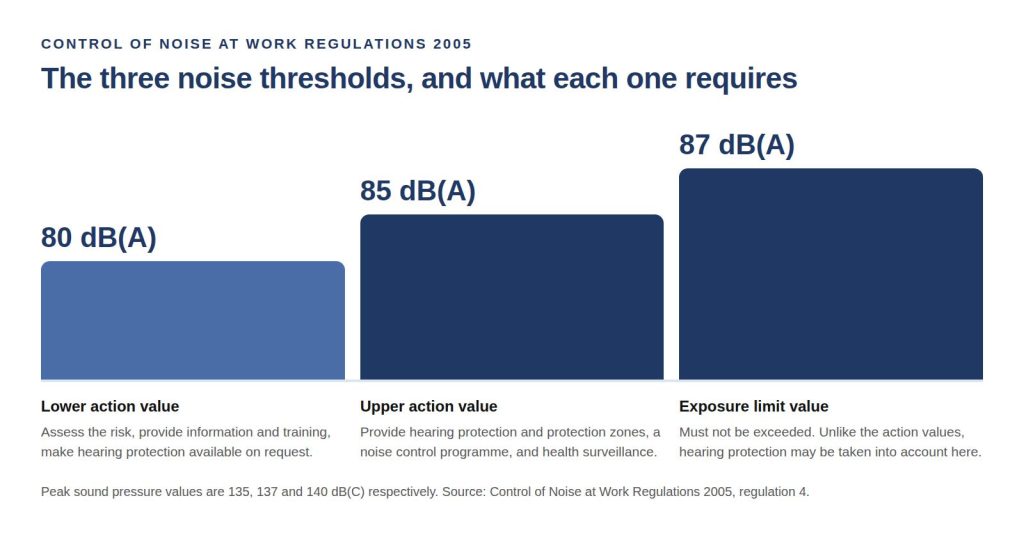
The Control of Noise at Work Regulations 2005 set three thresholds based on daily or weekly personal noise exposure. It is worth knowing them, because they apply to preventing further damage in the people you already employ, not only to new starters.
Threshold | Level | What the employer must do |
Lower exposure action value | 80 dB(A), peak 135 dB(C) | Assess the risk, provide information and training, and make hearing protection available on request. |
Upper exposure action value | 85 dB(A), peak 137 dB(C) | Provide hearing protection and hearing protection zones, introduce a planned programme of noise control, and provide health surveillance. |
Exposure limit value | 87 dB(A), peak 140 dB(C) | Exposure must not exceed this level. Unlike the action values, the protection given by hearing protection may be taken into account here. |
Health surveillance is required for employees regularly exposed above the upper action value, usually annually for the first two years and then at three-yearly intervals. A useful practical check from HSE: if people have to raise their voice to hold a normal conversation about two metres apart, or use noisy powered tools for more than half an hour a day, noise is likely to be a problem.
No-Cost and Low-Cost Workplace Adjustments
These adjustments support an employee who already has noise-induced hearing loss. They sit alongside, not instead of, your duties to control noise exposure.
Area | Suggested adjustment | Why it helps |
Briefings | Hold toolbox talks and briefings in a quiet area away from running plant, with the speaker facing the group. | Removes competing noise and allows lip reading, which most people do to some degree without realising. |
Instructions | Follow verbal instructions with a written or photographed version, including on site. | Gives a reliable record where a word may have been missed. |
Warning signals | Review whether the person can detect alarms and reversing alerts while wearing hearing protection, and add visual or vibrating alerts where needed. | Closes the safety gap HSE found in the large majority of workplaces inspected. |
Hearing protection | Check the attenuation is not excessive for the individual, and consider level-dependent or flat-attenuation protectors. | Over-protection makes speech and warnings harder to hear. HSE advises against reducing the level at the ear below 70 dB. |
Meetings | Use smaller rooms with soft furnishings, and switch on live captions for video calls. | Reduces reverberation and provides a written fallback at no cost. |
Telephony | Move to email, messaging or video with captions where the role allows, or provide an amplified handset. | The telephone is often the single hardest task and the easiest to work around. |
Rotas | Where practical, rotate the noisiest tasks and build in quieter recovery periods. | Reduces both further exposure and daily listening fatigue. |
Hints and Tips for Everyday Working
- Ask for the key points of a briefing in writing afterwards, rather than trying to catch every word at the time.
- Position yourself where you can see the speaker’s face, and away from the noisiest machinery in the room.
- Say early on that you may ask for things to be repeated, so it becomes normal rather than awkward.
- Use captions on video calls as standard rather than switching them on only when struggling.
- Report any change in your hearing or new tinnitus through health surveillance promptly, as it may indicate ongoing exposure.
- Keep a note of the situations where you miss information, since patterns are useful evidence when requesting adjustments.
Building Awareness and Communication
Noise-induced hearing loss carries a particular difficulty: colleagues in a noisy industry often assume that everyone struggles to hear, so they underestimate the difference between finding it hard and genuinely not receiving the information. That assumption is where safety-critical messages get lost.
Practical team habits make more difference than formal policy. Facing the person when speaking, moving away from plant before giving instructions, and confirming understanding rather than asking whether someone heard, all cost nothing. Deaf awareness training for supervisors is worth considering where a team works in high noise, because supervisors are usually the ones delivering the instructions that matter most.
For supervisors in particular, our deaf and hearing loss awareness e-learning is a practical starting point.
Legal Rights and Support
Under the Equality Act 2010, a condition counts as a disability where it has a substantial and long-term adverse effect on a person’s ability to carry out normal day-to-day activities. Noise-induced hearing loss is permanent, so where it has a substantial effect the duty to make reasonable adjustments applies. Separately, and regardless of whether the Equality Act threshold is met, the Control of Noise at Work Regulations 2005 duties apply to every employer whose staff are exposed at or above the action values.
Summary
Noise-induced hearing loss is the classic example of a condition where prevention and support have to run side by side. The exposure controls protect the hearing your workforce still has. The adjustments protect the person who has already lost some, and they are largely free: quieter briefings, written confirmation, captions, a review of whether alarms can actually be heard. The safety case and the inclusion case point in exactly the same direction here, which makes this an easier conversation to have with a board than most.
If you or someone in your team is deaf or has hearing loss and would like expert, tailored support to stay productive and comfortable at work, visit https://visualisetrainingandconsultancy.com/workplace-assessments/hearing-loss-workplace-assessment/ to arrange a hearing loss workplace assessment.
Frequently Asked Questions
No. HSE is unambiguous that it is permanent and incurable. Hearing aids can help make better use of the hearing that remains, but they do not restore what has been lost, which is why prevention matters as much as adjustment.
Employers must assess and control noise exposure under the Control of Noise at Work Regulations 2005, with health surveillance required above the upper action value, regardless of whether an employee already has hearing loss.
Written confirmation of verbal briefings, since safety-critical instructions are the highest-risk information to miss in a noisy environment.
Sources
- HSE, work-related hearing problems statistics: https://www.hse.gov.uk/statistics/causdis/deafness/index.htm
- Control of Noise at Work Regulations 2005, regulation 4: https://www.legislation.gov.uk/uksi/2005/1643/regulation/4
- HSE, noise at work guidance for employers: https://www.hse.gov.uk/noise/employers.htm
- HSE press release, serious gaps found in protecting workers from excessive noise, 10 September 2025: https://press.hse.gov.uk/2025/09/10/serious-gaps-found-in-protecting-workers-from-excessive-noise/
- RNID, noise-induced hearing loss: https://rnid.org.uk/information-and-support/hearing-loss/types-of-hearing-loss-and-deafness/noise-induced-hearing-loss/